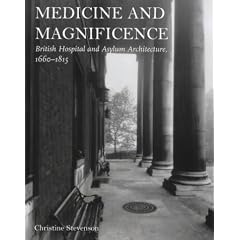
the other raining afternoon i was killing some waiting time at a secondhand bookshop and, as always, impulsively spending cash on some 'not-really-rare' stuff. in my defense, it is because i can't afford those 18-19C medical journals and that the excitement triggered by them must be released otherwise. then i found this book coinciding with my term paper on the topic of body/ space relationships in the (pre-) modern western medicine.
as the memories of my supervisor saying that 'you must be disappointed by the result... there's no necessary connection between the concept of city as a body and location of bodies in the city...' flashing back, it was embarrassing to recall that the periodization of my awkward term paper was in fact wrong. it was wrong not because there was a 'correct' option but due to my unsuccessful efforts devoted to dealing with some disjointed concepts at once. it might be too early to use the term disjointed, of course, since judging by the feedback i got, my efforts were not completely useless. a lack of case studies was however undermining my intended conclusion that surveillance of bodies had something to do with a seemingly well-circulating city in the 19C western europe.
to put it briefly, there were some sub-topics i tried to cover and the apparent mistakes i made:
1. translocation of patient bodies from streets, asylums and prisons to civil hospital and then to the anatomical table. which did happen, but in different ways, in the 19C paris and london.
where i was stuck in the variation of body-controlling factors such as the architecture, the bills and the professionalisation of medicine. also the objects, i. e. the bodies, were not well-defined according to the two different cultures.
2. high-speed and high-efficiency circulation of the city as a body. conception of such principles dated back to the 18C and, perhaps, were reinforced in the 19C in accordance with marxist ideas.
where i figured out a time lag between urbanisation of paris and british cities, but a single chapter was way too short for comparative study.
3. the idealistic rationality in control and direction of 'flows' in the city--flows of bodies and of air, traffic and services.
that is, i was trying to work on a very long period ranging from the 17C to early 20C. as a predictable result, without a central concern gluing all stuff together i drowned in all those urban history books--and did not survive.
4. disorder concealed behind orders.
this was perfectly beyond my ability... again when it was too short a paper to be covering both urban history and the history of medicine.
after all, whatever, it is over now. it is not over yet, however, because i'm still seeking other people's works that might fulfill my unfinished pursuit. to me it's like dealing with a jigsaw puzzle, when i pick up as many perspectives as i want in hope of exploring the whole picture. nonetheless i have no idea if this game is really leading somewhere. but when it is just a pastime rather than academic assignment, what's the problem with an extremely vague picture in mind?


No comments:
Post a Comment